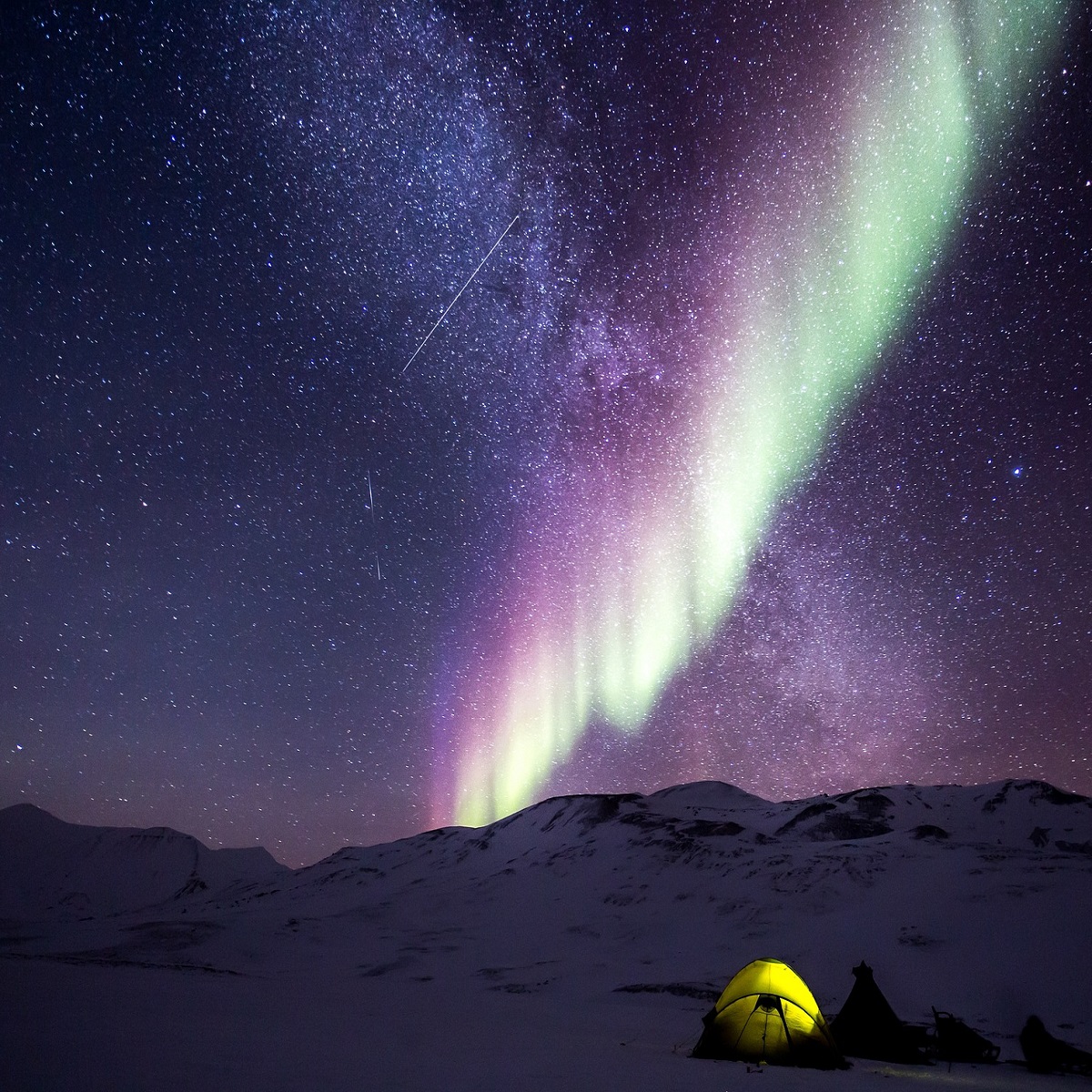
The Aurora Borealis (Northern Lights) and Aurora Australis (Southern Lights) are among the most breathtaking spectacles in nature. These dazzling light displays paint the night sky near Earth’s polar regions with shimmering curtains, waves, and arcs of vibrant color. But what causes these ethereal lights, and how can we witness their magic?
The Sun constantly emits a stream of charged particles known as the solar wind. When these particles reach Earth, they are guided by the planet’s magnetic field towards the poles. There, they collide with oxygen and nitrogen atoms in the atmosphere. This collision transfers energy, and when these excited atoms return to their normal state, they release this energy as light, creating the auroras we see.
The Cosmic Palette: Why Different Colors Appear
The mesmerizing array of colors in an aurora is not random; it’s a direct result of the specific atmospheric gases involved in the collisions and the altitude at which they occur:
- Green: This is the most common and iconic aurora color, produced by oxygen atoms excited at lower altitudes (around 100-300 km).
- Red/Pink: Higher-altitude oxygen (above 300 km) often produces rarer red auroras. These can appear as a reddish fringe above green lights or dominate the entire display during very intense solar storms.
- Blue/Purple: Nitrogen molecules, when ionized and excited, tend to create blue or purple hues, usually visible at lower altitudes and often appearing at the bottom edges of the aurora.
The mix of these colors, constantly shifting and flowing, creates the dynamic and otherworldly beauty that captivates observers.
The Sun’s Influence: Solar Cycles and Aurora Activity
The frequency and intensity of auroral displays are directly linked to the Sun’s activity, which follows an approximately 11-year cycle known as the solar cycle. During a solar maximum, when the Sun is most active, it produces more sunspots, solar flares, and coronal mass ejections (CMEs) – all sources of charged particles that travel towards Earth. This heightened activity significantly increases the chances of seeing strong and widespread auroras. Conversely, during a solar minimum, the Sun is quieter, and auroral displays are generally less frequent and less intense. We are currently approaching or in a period of increased solar activity, which explains the recent widespread aurora sightings.
Beyond Their Beauty: Effects on Earth
Beyond their sheer beauty, auroras are a vivid reminder of the dynamic interaction between the Sun and Earth. Intense solar activity, which fuels the solar wind, can have significant effects beyond the visual display. These powerful solar events can disrupt satellite communication, interfere with power grids, and even affect Earth’s magnetic field, highlighting the practical importance of space weather monitoring.
Ancient Wonders: Cultural Significance of the Lights
For millennia, the auroras have inspired awe and wonder, leading to a rich tapestry of myths and legends across various cultures. Indigenous peoples of the Arctic, such as the Inuit and Sámi, often viewed them as spirits dancing in the sky, or even as messages from ancestors. Norse mythology interpreted them as the shimmering armor of the Valkyries. These diverse interpretations underscore humanity’s deep and ancient connection to the celestial phenomena.
Witnessing the Spectacle: Tips for Aurora Chasers
If you dream of witnessing these celestial lights, here’s what you need to know:
- Where to Go: The Aurora Borealis is typically visible in regions near the North Pole, such as Alaska, Canada, and Scandinavia. The Aurora Australis graces the skies near the South Pole, in places like Antarctica, Australia, and New Zealand. Optimal viewing latitudes are generally within the “auroral oval” – a band around Earth’s magnetic poles.
- When to Watch: Auroras are best seen on clear, dark nights during the active period of the solar cycle. Monitor aurora forecasts from space weather agencies, as these lights are notoriously unpredictable. Winter months offer longer periods of darkness, increasing viewing opportunities.
- Finding Your Spot: Get away from city lights and light pollution, which can significantly diminish the visibility of the aurora. Find a location with a wide, unobstructed view of the northern or southern horizon.
- Expanded Viewing Opportunities (Recent Example): In May 2024, heightened solar activity created a rare opportunity to see auroras far beyond their usual polar regions. This meant more temperate latitudes, like northern Europe and parts of the northern United States, experienced these mesmerizing displays. Such events highlight the ever-changing nature of our solar system and the potential for unexpected celestial wonders.
Witnessing the aurora is an experience that connects us to the power and beauty of our planet and the Sun. It requires patience and planning, but the reward is a memory that will last a lifetime, reminding us of the dynamic, living universe we inhabit.